

Few materials are as deeply woven into Melbourne’s outdoor aesthetic as bluestone. Walk through any established suburb — from Eltham and Kew to Doncaster East and Alphington — and you’ll find bluestone underfoot, framing gardens, bordering pools, and anchoring outdoor living spaces with quiet authority. Its blue-grey tones, natural texture, and exceptional durability make it one of the most sought-after materials in residential landscape design.
At John French Landscape Design, we’ve been creating landscapes in Melbourne since 1981. Over four decades, bluestone has remained one of our most trusted materials — versatile enough to suit a native Australian garden, a formal French provincial design, or a clean contemporary outdoor room. This guide covers everything Melbourne homeowners need to know about bluestone landscape design: what it is, how it’s used, which styles it suits best, and how to get it right from the ground up.
What Is Bluestone? Understanding Melbourne’s Favourite Paving Material
In Victoria, “bluestone” refers to basalt — a dense volcanic rock formed by ancient lava flows. It’s named for its characteristic blue-grey colouring, though individual pieces can range from near-black to warm silver depending on the quarry and finish. Melbourne has a long history with the material; it lines the laneways of the CBD and underpins the foundations of heritage buildings across the inner suburbs. For projects where weight loading is a key consideration, it’s worth reading our full guide on designing a rooftop garden — including which lightweight materials work best as alternatives to traditional stone in elevated garden settings.
For residential landscape design, bluestone offers a combination of properties that few materials can match:
- Density and strength: Basalt is one of the hardest volcanic rocks, making it highly resistant to wear, cracking, and frost
- Slip resistance: When finished correctly (flamed or rough-sawn), it provides excellent traction around pools and on steps
- Timeless aesthetic: Its neutral palette works across contemporary, heritage, and naturalistic design styles
- Thermal performance: Dense stone heats slowly and cools quickly, making it comfortable underfoot in Melbourne’s variable climate
One important distinction: Australian bluestone — typically sourced from Victorian quarries — differs meaningfully from imported Chinese basalt marketed under the same name. Australian stone tends to be denser, lower in porosity, and more consistent in colour and quality. Imported alternatives are generally more affordable, but greater variation in softness and porosity means installation and long-term performance can vary significantly.
Five Ways Bluestone Elevates Melbourne Landscape Design
1. Paving for Patios, Alfresco Areas & Courtyards
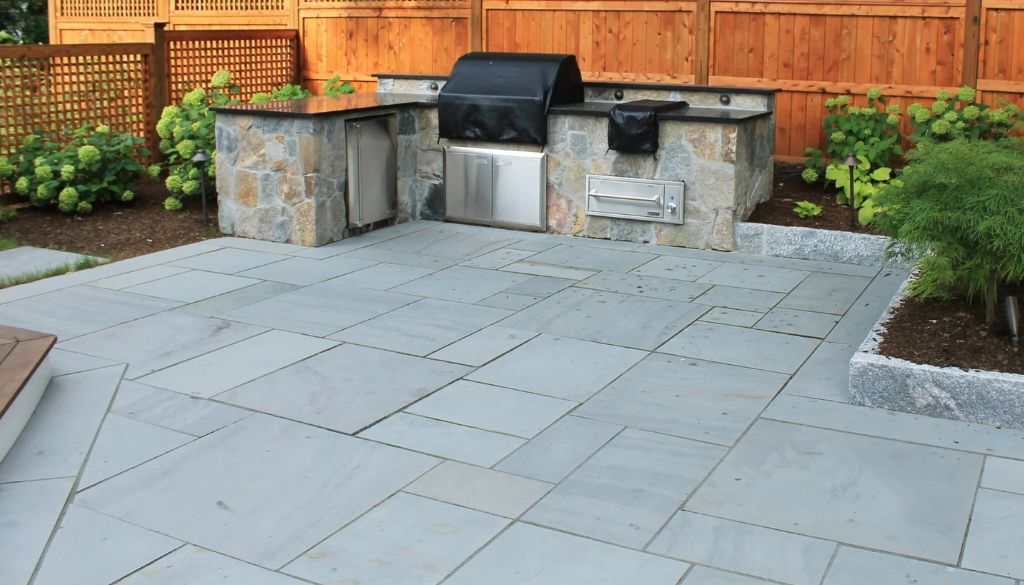
Bluestone paving is the most common application in residential landscapes, and for good reason. Large-format sawn pavers in 600×400mm or 600×600mm create clean, architecturally resolved surfaces that pair naturally with timber screening, steel-edge garden beds, and native or exotic plantings.
Thickness matters more than many homeowners realise. Pavers under 20mm are prone to movement and edge chipping if not bedded on a rigid substrate with rapid-setting adhesive. For outdoor living areas with regular foot traffic, a minimum 30mm thickness on a properly prepared concrete slab is the standard recommendation from experienced Melbourne landscapers.
Finish selection also dramatically changes the character of the material:
- Honed: Smooth and matte — elegant for indoor-outdoor transitions and sheltered courtyards
- Flamed: Textured by heat treatment — ideal for pool surrounds and areas requiring slip resistance
- Natural split: Irregular surface adds organic character — well suited to native gardens and bush-style designs
2. Pool Surrounds
Bluestone is arguably Melbourne’s most popular pool coping and surround material. Flamed or bush-hammered finishes provide the grip needed around wet surfaces, while the stone’s thermal density means it doesn’t heat to uncomfortable temperatures on summer afternoons the way lighter-coloured limestone can.
At John French Landscape Design, we integrate bluestone pool surrounds with the surrounding garden landscape — using consistent stone for garden edging, steps, and retaining walls to create cohesion across the entire outdoor space. This whole-of-garden thinking is particularly important on the sloped and irregular blocks common in Eltham, Viewbank, and the Diamond Creek corridor.
For more on how hardscape materials can be coordinated across a landscape, see our guide to best hardscaping materials for Melbourne gardens.
3. Steps & Level Transitions
Few landscape elements make a stronger visual statement than well-proportioned bluestone steps. Irregular-edged treads — often supplied as slab cuts rather than precision-machined pavers — create a natural rhythm between garden levels that looks like it belongs to the landscape rather than being placed upon it.
This is especially relevant for the many Melbourne gardens built on significant slope changes. Retaining levels with bluestone steps, rather than a single large retaining wall, allows planting pockets and soft edges to break up the mass, resulting in landscapes that feel considered and liveable rather than engineered.
Steps also provide an opportunity to weave planting through hardscape. Low-spreading natives between treads, or a single feature grass in a gap between landing levels, integrate the built and planted elements in ways that purely concrete solutions rarely achieve. For planting inspiration to complement your stonework, explore our article on low-maintenance shrubs suited to Melbourne gardens.
4. Retaining Walls & Feature Stonework
Bluestone’s mass and density make it structurally reliable for load-bearing applications. Sawn basalt blocks can be mortared or dry-stacked to create retaining walls that handle Melbourne’s variable rainfall and clay-heavy soils — both of which exert significant pressure on landscape structures over time.
Beyond structural retaining walls, bluestone works beautifully as feature stonework: fire pit surrounds, raised garden bed borders, outdoor seating walls, and entry feature walls. These elements anchor a landscape design and create the kind of material continuity that distinguishes a designed garden from a collected one.
If you’re planning improvements to your home’s boundaries or side corridors, our article on landscaping ideas for the side of house covers how hardscape materials including bluestone can transform often-overlooked spaces.
5. Driveways & Entry Areas
Bluestone’s durability makes it suitable for vehicle traffic when installed on a properly reinforced concrete slab. Cobble-format paving or large-slab driveways in bluestone create a premium first impression that blends seamlessly with Melbourne’s heritage and contemporary residential architecture alike.
Entry areas in particular benefit from the material — a bluestone path from gate to front door, combined with a stone feature planter or low retaining border, creates arrival sequences that feel intentional and resolved. This kind of considered approach to the complete garden journey is something we discuss in detail on our projects page.

Which Landscape Styles Work Best with Bluestone?
One of bluestone’s greatest strengths is its design versatility. It shifts character dramatically depending on finish, format, and what it’s paired with. Below are the styles where Melbourne homeowners most commonly use it — and how we approach each at John French Landscape Design.
Contemporary & Minimalist
Large-format honed pavers, tight joints, clean lines, and a monochromatic palette of black steel, concrete, and timber. Bluestone’s neutral grey anchors these schemes without competing with architectural elements. Planting is typically bold and sculptural — ornamental grasses, strappy-leafed natives, or clipped topiary.
Australian Native & Bush Garden
Natural-split or rough-sawn bluestone integrates naturally into native garden settings. Irregular treads, dry-stack retaining walls, and gravel infill between pavers create a landscape that feels like it evolved rather than was installed. This is the style John French has championed since the early 1980s, drawing on the Ellis Stones tradition of working with Melbourne’s natural materials and topography.
Heritage & Federation
Melbourne’s inner-ring suburbs are filled with federation-era homes that suit cobblestone-style bluestone paving, mortared retaining walls, and formal garden structures. Bluestone’s historical use in Melbourne streets and buildings gives it an authentic quality that modern alternatives cannot replicate.
Balinese & Resort-Inspired
Darker flamed finishes paired with lush tropical planting, water features, and timber create resort-style outdoor rooms that translate surprisingly well to Melbourne’s climate when designed correctly. The density of bluestone’s dark tones anchors the warmth of timber and the richness of tropical foliage.
What to Know Before Specifying Bluestone: Practical Guidance for Melbourne Homeowners
Preparation is Everything
No material compensates for poor sub-base preparation. On Melbourne’s reactive clay soils, inadequate ground preparation leads to pavers lifting, cracking, and creating drainage issues within a few years. A proper concrete slab, correct drainage design, and experienced installation make the difference between a landscape that looks good for 40 years and one that needs remediation in five.
Natural Variation is a Feature
Bluestone contains natural mineral variations — sometimes called “cats paws” — as well as veining, tonal shifts, and surface texture differences. These are characteristics, not defects. Homeowners seeking perfect uniformity should discuss their expectations with their designer at the outset, as heavily selected stone or a more engineered look may better suit some projects.
Sealing and Maintenance
Whether to seal bluestone is a question of use context. High-traffic areas, outdoor kitchens, and food preparation zones generally benefit from sealing to resist staining. Unsealed natural stone develops a patina over time that many homeowners prefer. Either way, avoid acidic cleaners, ensure good drainage to prevent efflorescence, and clean spills from organic sources promptly.
Budget Expectations
Bluestone sits at the premium end of paving materials. Australian-sourced stone commands higher prices than imported alternatives, and installation requires skilled tradespeople working to exacting standards. For most residential projects, bluestone paving and construction form part of a broader landscaping scope. At John French Landscape Design, typical project values range from AUD $20,000–$80,000 — reflecting the comprehensive design, construction administration, and managed handover service we provide.
How John French Landscape Design Approaches Bluestone Projects
Since 1981, John French has been designing and constructing landscapes across Melbourne’s northern and eastern suburbs — Eltham, Alphington, Kew, Doncaster East, Viewbank, and surrounding areas. Every project begins with an in-home consultation, moves through a considered design process, and is delivered with full construction administration to ensure the finished garden matches the design intent.
Bluestone features in many of our projects, but never in isolation. We specify it as part of a cohesive material palette — selected to suit the home’s architecture, the site’s topography, and the garden’s intended character. Whether it’s a native garden with dry-stack stone retaining walls on a sloped Eltham block, or a contemporary courtyard with large-format paving and pool integration in Kew, the material works hardest when it’s part of a resolved whole.
If you’re starting to think about your outdoor space and aren’t sure where to begin, our beginner’s guide to landscaping is a good place to start before booking a consultation.
Frequently Asked Questions About Bluestone Landscape & Design
Is bluestone suitable for Melbourne’s climate?
Yes. Bluestone (basalt) is one of the most climate-resilient paving materials available in Victoria. Its density means it handles frost, summer heat, and Melbourne’s heavy clay-soil movement better than softer stones like sandstone or limestone. When installed on a properly prepared sub-base with adequate drainage, bluestone performs reliably across decades of Melbourne’s variable weather conditions.
What’s the difference between Australian and imported bluestone?
Australian bluestone — quarried predominantly in Victoria — is denser, less porous, and more consistent in colour and quality than imported Chinese basalt sold under the same name. Imported stone is generally more affordable, but greater variation in hardness and porosity means it can be more susceptible to surface wear, staining, and movement over time. For high-traffic areas, pool surrounds, and long-term landscape investments, Australian-sourced stone is typically the better specification.
How much does a bluestone landscaping project cost in Melbourne?
Bluestone sits at the premium end of paving materials, and costs vary depending on stone origin (Australian vs imported), format, finish, and the complexity of installation. At John French Landscape Design, typical residential project values range from AUD $20,000–$80,000 — covering design, construction administration, and full project handover. The best way to get an accurate estimate is through an in-home consultation where we can assess your site, discuss your brief, and outline a realistic scope and budget.
Does bluestone need to be sealed?
Not always — it depends on how and where it’s used. Sealed bluestone resists staining more effectively, making it a sensible choice for outdoor kitchens, entertaining areas, and food prep zones. In garden paths, naturalistic settings, or areas away from foot traffic, many homeowners prefer to leave it unsealed so it develops a natural patina over time. Either way, avoid acidic cleaners, maintain good drainage to prevent efflorescence, and address organic spills promptly regardless of sealing status.
Can bluestone be used on a sloped block?
Absolutely — and it’s one of the materials we recommend most often for Melbourne’s hilly northern and eastern suburbs. On sloped sites like those common in Eltham, Viewbank, and the Diamond Creek corridor, bluestone steps and dry-stack retaining walls create level transitions that are both structural and visually cohesive. The key is careful drainage design and experienced installation — slope and clay soils together demand a sub-base and waterproofing approach that accounts for soil movement and water run-off before a single stone is laid.
Ready to Transform Your Garden with Bluestone?
John French Landscape Design has been creating award-winning landscapes in Melbourne since 1981. Contact us to discuss your project and arrange an in-home consultation.
📞 0419 725 344 | 📧 info@johnfrenchlandscapes.com.au | 📍 3/29 Susan St, Eltham VIC 3095
