
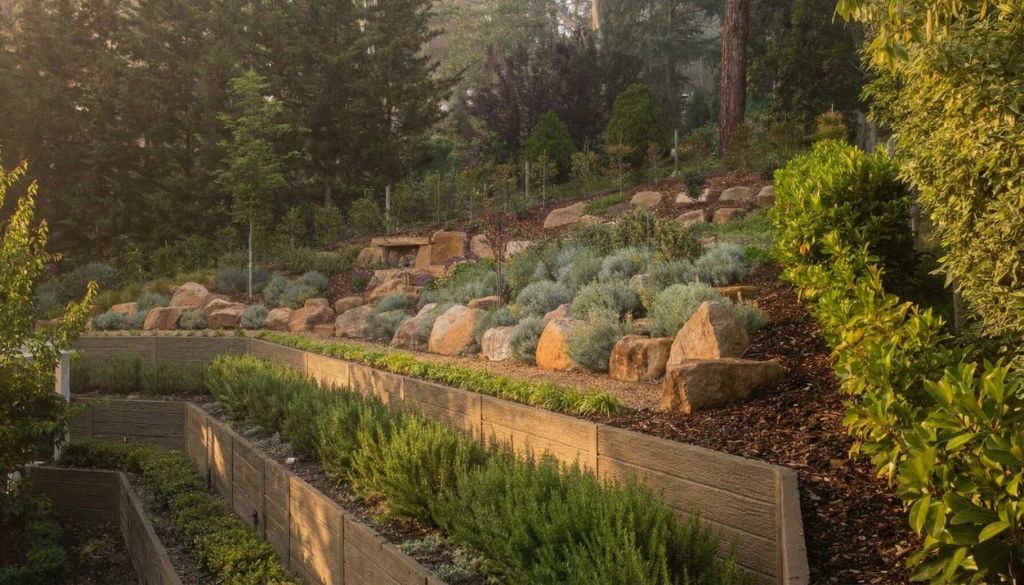
A steep hillside is one of the most challenging features a homeowner can face—but it is also one of the most rewarding to get right. What looks like an unusable slope can become a layered, dynamic garden that adds dimension, privacy, and genuine character to a property. The key is approaching the project with a clear understanding of what the slope demands: managing water, stabilising soil, creating safe access, and choosing plants that will thrive rather than struggle. Sloped blocks often have exposed sight lines that flat properties do not—layered plants chosen for backyard privacy and screening can solve this while also helping to stabilise the hillside with their root systems.
Across Melbourne’s northeast suburbs—from Eltham and Viewbank to Doncaster East and Templestowe—sloped and undulating blocks are common. Many homeowners inherit steep sections that have been left as overgrown scrub or bare clay, unsure where to begin. This guide walks through the practical considerations, design options, and planting strategies that turn a steep hillside from a liability into a landscape feature. Slim-profile corten steel retaining walls and planters are an excellent choice for terraced hillside designs where space is limited and durability is essential.
Why Steep Hillsides Are Challenging to Landscape
Steep slopes present three interconnected problems. The first is erosion. Rainfall that would soak into flat ground instead rushes downhill on a slope, carrying topsoil, mulch, and nutrients with it. Over time, this strips the hillside back to compacted subsoil where very little will grow without intervention.
The second challenge is access. Working on a steep gradient is physically demanding and can be unsafe. Moving materials, operating equipment, and even routine maintenance tasks like pruning or mulching become significantly harder when the ground falls away beneath you. Gabion baskets are one of the most effective and visually striking options for terracing steep gradients — explore our full collection of gabion wall ideas for slopes and retaining features to see how they can transform a challenging hillside.
The third is cost uncertainty. Steep sites can require engineered retaining walls, drainage infrastructure, and earthworks that push budgets well beyond a standard garden project. Understanding which interventions are genuinely necessary—and which can be avoided through smarter design—is essential before committing to any approach.
First Things to Consider Before You Start
Understanding Your Slope
Before any design work begins, you need to understand what you are working with. The gradient of the slope determines which solutions are feasible. A gentle slope of 1:6 or less can often be managed with planting alone. Moderate slopes between 1:4 and 1:6 may benefit from a combination of terracing and deep-rooted planting. Slopes steeper than 1:3 typically require structural intervention—retaining walls, engineered drainage, or significant earthworks.
Orientation matters too. A north-facing slope in Melbourne receives substantially more sun and dries out faster, while a south-facing slope retains moisture and may support different plant communities. Observe how water moves across the site during rain. Identifying natural drainage lines and areas where water pools or accelerates helps inform where to place swales, planting, or hardscape elements.
Rules, Permits, and Environmental Factors
In Victoria, any retaining wall over one metre in height generally requires a building permit and engineering certification. Stormwater management is regulated by local councils, and directing runoff onto neighbouring properties can create legal liability. If your slope contains significant native vegetation, removal may require a planning permit under the local overlay.
Before breaking ground on a steep hillside project, check with your local council about permit requirements, stormwater obligations, and any vegetation protection overlays that apply to your property. This step can save significant cost and complication later in the process.
Structural vs Natural Landscaping Approaches
When Retaining Walls Are Needed
On very steep slopes—particularly those above a 1:3 gradient or where the hillside sits close to a structure, boundary fence, or pool—retaining walls become a practical necessity rather than a design choice. A well-engineered retaining wall holds soil in place, creates level planting areas, and provides structural certainty that planting alone cannot achieve.
Tiered retaining systems, where multiple lower walls step up the hillside rather than one tall wall, distribute load more effectively and create opportunities for planting between levels. Materials range from natural stone and timber sleepers to concrete block and corten steel, each offering a different aesthetic. Adequate drainage behind the wall—typically an ag-pipe and gravel drainage layer—is critical to prevent hydrostatic pressure from building up and compromising the structure. For inspiration on integrating natural stone into sloped landscapes, explore these pool landscaping ideas with rocks that demonstrate how stone features anchor multi-level designs.
Landscaping a Steep Hillside Without Retaining Walls
Not every slope requires engineered walls. Where the gradient is moderate and there is no immediate risk to structures, a naturalistic approach using earth shaping, contour planting, and groundcover stabilisation can be equally effective—and significantly less expensive.
Working with the natural contours of the land rather than fighting them is the foundation of this approach. Gentle earth terraces carved into the slope create horizontal planting pockets without formal walls. Deep-rooted native shrubs and grasses bind the soil, while dense groundcovers protect the surface from rain impact and slow water movement across the slope.

Terracing a Steep Hillside
Terracing transforms a continuous slope into a series of level or near-level platforms. This is one of the oldest and most effective techniques for managing steep land, and it works at every scale—from a small backyard slope to a full hillside.
Earth terraces use the cut-and-fill method: soil is excavated from the uphill side and placed on the downhill side to create a flat bench. The riser between terraces can be stabilised with timber, stone, or dense planting. For smaller residential slopes, recycled hardwood sleepers or locally sourced stone make practical and attractive riser materials.
Each terrace becomes a usable zone—space for a garden bed, a seating area, a productive vegetable patch, or simply a safe, level area for children and pets. The horizontal surfaces slow water dramatically, giving it time to soak into the soil rather than running off.
Preventing Erosion and Managing Water
Slowing and Absorbing Water
Erosion control on a steep hillside is fundamentally about slowing water down and giving it somewhere to go. Swales—shallow channels that run across the slope on contour—intercept runoff and spread it along the hillside, allowing it to soak in gradually. Dry creek beds serve a similar function while adding a naturalistic design element.
Heavy mulching with coarse organic mulch protects exposed soil from rain impact and reduces surface runoff. Groundcover planting provides long-term surface protection once established. The combination of mulch for immediate cover and groundcovers for permanent stabilisation is one of the most reliable erosion management strategies for residential slopes. Homeowners managing water across their entire property should also consider broader water conservation garden strategies that complement hillside drainage planning.
Temporary Stabilisation Techniques
While plants establish, bare slopes remain vulnerable. Jute or coir erosion matting pegged across the surface provides immediate protection and biodegrades as planting fills in. Fast-growing green manure crops—such as clover or rye—can stabilise soil within weeks and be slashed back once permanent plantings take hold.
On very steep exposed sections, timber or recycled pallet check dams placed across drainage lines slow concentrated water flow and trap sediment until vegetation establishes. These are low-cost, temporary measures that buy time for a longer-term planting strategy to take effect.
Best Plants for Steep Hillsides
Groundcovers and Grasses
The backbone of any planted slope is its groundcover layer. Mat-forming species with dense root systems hold soil, suppress weeds, and protect the surface from erosion. Native options like Myoporum parvifolium, Grevillea ‘Royal Mantle’, and Hardenbergia violacea spread effectively on slopes and tolerate Melbourne’s dry summers once established.
Ornamental grasses—including Lomandra longifolia, Dianella caerulea, and Poa labillardieri—provide deep root systems that stabilise soil at depth while adding texture and movement to the hillside. These species are low-maintenance and drought-tolerant, making them practical choices for slopes that are difficult to access for regular care. For a comprehensive species guide, see our detailed article on the best plants for landscaping steep slopes.
Shrubs and Trees for Slopes
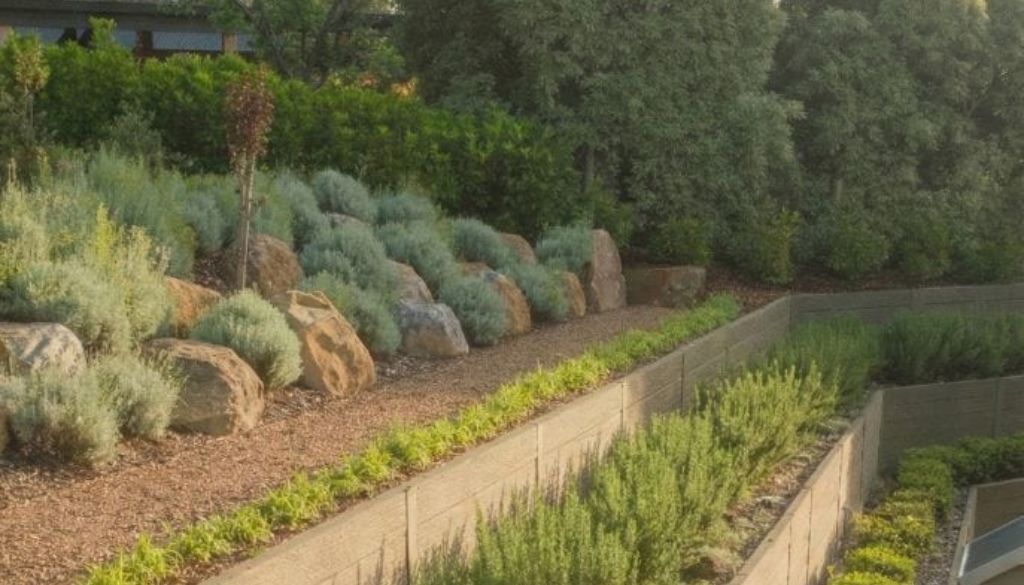
Mid-layer shrubs add structure and help break up the visual mass of a planted slope. Westringia, Correa, Callistemon, and Leptospermum all have root systems that contribute to soil stability while providing year-round foliage and seasonal flowers. Nitrogen-fixing species like Acacia cognata improve soil health over time, benefiting surrounding plants.
Trees should be selected carefully on steep sites. Deep-rooted species that do not develop aggressive surface roots are preferable. Eucalyptus varieties suited to the local area provide canopy and habitat, but placement should consider their mature size and any impact on retaining structures or drainage. In bushfire-prone areas across Melbourne’s outer northeast, plant selection on slopes also needs to account for fire safety—our guide to fire resistant landscaping covers how to choose and position species that reduce bushfire risk.
Access, Paths, and Movement on Slopes
Safe, comfortable access is often the element that determines whether a hillside garden actually gets used or simply gets admired from a distance. Steps are the most common solution, and the design options range from formal stone staircases to informal stepping stones set into the slope.
The safest gradients for garden steps use a riser height of around 150mm and a tread depth of at least 300mm. Non-slip surfaces—textured stone, exposed aggregate concrete, or timber with anti-slip strips—are essential on any slope where moisture and shade are factors. On very long slopes, landings every eight to ten steps provide rest points and opportunities to change direction, which also reduces the visual impact of a long straight staircase.
Winding paths that traverse the slope at an angle rather than climbing directly are gentler on the body and create a more immersive garden experience. Gravel paths edged with timber or stone work well on moderate gradients, while steeper sections may require formed steps or engineered surfaces. Replacing turf on steep sections that are difficult to mow with dense groundcover planting is another practical move—explore sustainable lawn alternatives that work well on sloped terrain.
Turning a Steep Hillside into a Feature
A well-designed hillside garden offers something that flat gardens simply cannot: layers, depth, and natural drama. Terraced planting beds at different heights create a cascading effect that draws the eye upward. Borrowed views—glimpses of distant treetops, sky, or neighbouring canopy—extend the perceived boundaries of the garden.
Rock gardens work particularly well on slopes, with boulders and stone groupings arranged to mimic natural outcrops. Combined with alpine or drought-tolerant planting, a rocky slope becomes a low-maintenance feature with year-round texture and interest. Lighting installed along paths and among planting can transform a hillside garden after dark, turning what might feel inaccessible during the day into a dramatic focal point at night.
When to Call a Professional
Some hillside projects sit comfortably within DIY capability—planting a moderate slope with groundcovers, building low timber-edged terraces, or installing a simple stepped path. Others require professional involvement for safety, compliance, and long-term reliability.
If your slope is steeper than 1:3, sits above or below a structure, requires retaining walls over one metre, or involves significant earthworks or drainage infrastructure, engaging a qualified landscape designer and builder is the safest and most cost-effective path forward. Engineering certification, council liaison, and construction management are aspects that a professional can handle efficiently and correctly.
With over 40 years of experience designing and building landscapes across Melbourne’s sloped and undulating terrain, John French Landscape Design understands the unique challenges that steep blocks present. From initial site assessment through to design, construction administration, and handover, we manage every stage of the process. Book a consultation to discuss your hillside project today.
Frequently Asked Questions
How steep is too steep to landscape?
Slopes steeper than 1:3 (approximately 33%) are difficult to landscape with planting alone and typically require structural elements such as retaining walls or engineered terracing. Any slope steeper than 1:2 should involve professional assessment before work begins.
Do I need a retaining wall on a steep hillside?
Not always. Moderate slopes can often be managed with terracing, contour planting, and erosion control techniques. Retaining walls become necessary when the gradient is extreme, when the slope is close to structures, or when level usable areas are required.
What plants stop erosion on slopes?
Deep-rooted groundcovers like Myoporum parvifolium, Hardenbergia violacea, and native grasses such as Lomandra and Dianella are among the most effective species for slope stabilisation in Melbourne’s climate.
Is it safe to DIY a steep hillside project?
Minor planting and mulching on moderate slopes is generally manageable. However, any project involving earthworks, retaining walls over one metre, or drainage infrastructure should involve qualified professionals for safety and compliance.
