
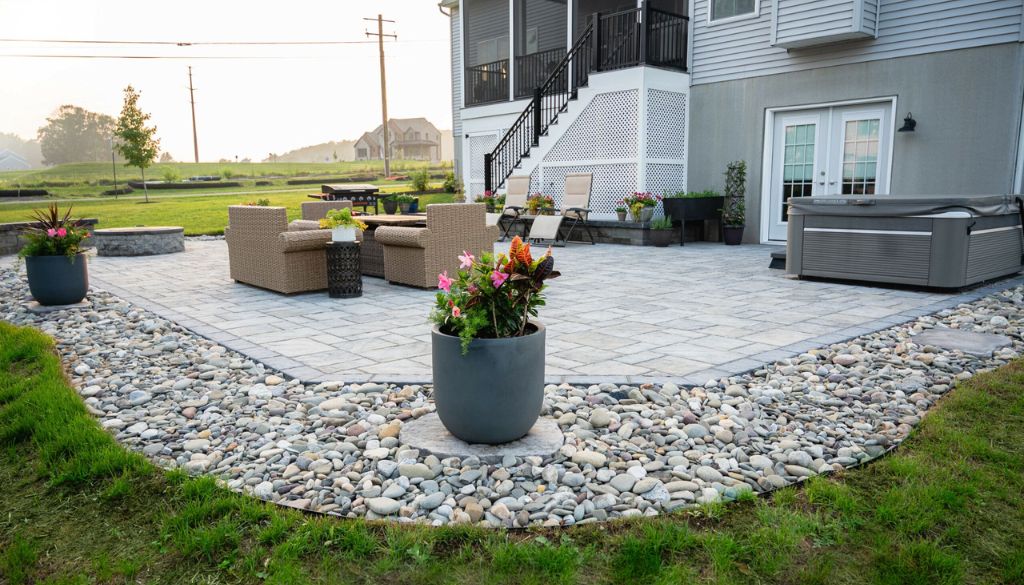
As Melbourne’s climate becomes increasingly unpredictable — swinging between drought conditions and intense storm events — more homeowners are rethinking how their outdoor spaces manage water. Permeable landscaping offers a practical, beautiful answer. Rather than sealing your garden beneath conventional asphalt and concrete, permeable systems allow rainwater to pass through the surface, infiltrate the soil, and support the natural hydrological cycle.
Whether you’re redesigning a driveway, creating a new entertaining patio, or building a garden path, choosing the right permeable materials can reduce flooding, improve plant health, and make your outdoor space far more resilient — all while looking exceptional. Taking sustainable water management a step further, our guide to green roof and rooftop garden design explains how rooftop planting systems absorb rainfall, reduce runoff, and improve insulation across Melbourne homes.
What Is Permeable Landscaping?
Permeable landscaping refers to surfaces, materials, and design approaches that allow water to pass through them rather than channelling it into stormwater drains or allowing it to pool. Traditional sealed surfaces — asphalt driveways, standard concrete patios — are impermeable: water cannot soak through, so it runs off, picks up pollutants, and either floods low points in the garden or overloads council drainage systems.
Permeable systems work differently. Whether it’s a gravel path, a mulched garden bed, a driveway made from interlocking permeable pavers, or simply natural stone stepping stones set into the soil, these surfaces let water filter down into the substrate below. This supports the local water cycle, reduces erosion, maintains soil moisture, and keeps urban waterways cleaner.
The contrast couldn’t be more stark: a conventional concrete driveway sheds almost 100% of rainfall as runoff, while a well-designed permeable driveway can absorb the same water in place, delivering it to the root zone of surrounding plants.
Why Permeable Landscaping Matters
Reduces Runoff and Flooding
Flash flooding is an increasing problem in Melbourne’s established suburbs, particularly on properties with sloped blocks or where adjacent impermeable surfaces funnel water toward homes. Permeable landscaping slows stormwater flow, reduces the volume reaching drains during heavy rain events, and prevents the erosion that conventional surfaces accelerate. For properties in Eltham and surrounding areas — where blocks often feature gentle to moderate slopes — this is especially relevant.
Improves Water Quality
One of the most compelling environmental arguments for permeable landscaping is its filtration capacity. As water passes through permeable systems, physical filtration and microbial activity in the substrate remove a significant proportion of common urban pollutants:
- Up to 80% of sediment
- Up to 60% of phosphorus
- Up to 80% of nitrogen
- Up to 70% of heavy metals
- Up to 98% of oils and greases (where a sand layer is incorporated)
This makes permeable surfaces a genuine environmental asset, reducing the pollution load that eventually reaches local waterways, wetlands, and the broader catchment.
Supports Plant Health
Sealed surfaces don’t just cause flooding — they starve plant root systems of water. Permeable landscaping ensures that rainfall reaches the root zone of trees and garden beds, maintaining soil moisture during dry periods and reducing the need for supplemental irrigation. This is particularly valuable in drought-prone summer conditions, when Melbourne gardens can go weeks without meaningful rainfall.
Permeable surfaces also help prevent soil compaction around tree root systems — a leading cause of tree decline in established gardens. For more on pairing the right plants with your landscape design, see our guide on low-maintenance shrubs for your garden.
Types of Permeable Landscaping Materials
Gravel and Crushed Rock
Gravel is one of the most versatile and cost-effective permeable materials available. Its high infiltration rate makes it ideal for driveways, garden paths, and utility areas. The key to a well-performing gravel surface is the substrate preparation — a fine-free crushed rock base allows water to pass through freely without becoming compacted or waterlogged over time. Gravel does require periodic topping up as it shifts and settles with use, but ongoing maintenance costs are low.
Mulch (Bark, Wood Chips, Pebbles)
Organic mulch — bark, wood chips, or larger decorative pebbles — is one of the most permeable options available and one of the most beneficial for garden beds. Beyond its drainage properties, mulch retains soil moisture, moderates soil temperature, suppresses weeds, and gradually improves soil structure as it breaks down. For garden beds in particular, a 75–100mm layer of quality mulch around plants can dramatically reduce irrigation requirements. Pebble mulch offers similar drainage benefits with lower ongoing maintenance.
Natural Stone and Cobbles
Set into a compacted gravel or sand base rather than mortar, natural stone and cobbles allow water to infiltrate through the gaps between individual pieces. These materials offer strong visual appeal — they complement native, cottage, and formal garden styles equally — and carry a higher installation cost that reflects their durability and aesthetic quality. Cobbles work particularly well in courtyards, along pathways, and as decorative borders around garden beds.
Permeable Pavers
Modern permeable paving systems offer a compelling alternative to standard concrete or brick pavers for driveways, paths, and entertaining areas. Options include concrete pavers with deliberately sized joint gaps filled with fine-free crushed rock, plastic grid systems that support grass or gravel infill, and pebble-based permeable paver products. A cost-effective approach for larger surfaces is to alternate standard pavers with permeable sections, achieving adequate drainage without the full cost of an entirely permeable system.
Grass Pavers
Grass paver systems — either plastic or concrete grids filled with turf or gravel — are well suited to areas that require load-bearing capacity alongside permeability. Common applications include driveways used infrequently, overflow parking areas, and utility access paths. The grass or gravel infill maintains a natural appearance while the structural grid distributes vehicle loads across a wider area, preventing rutting and compaction.

Permeable Landscaping Around Trees
Trees are among the most valuable assets in any residential garden, and their long-term health depends heavily on the surfaces around their root systems. Hard-sealed surfaces around tree trunks — particularly on established trees in urban gardens — restrict water, oxygen, and nutrient movement into the root zone, accelerating decline.
Tree Surround Systems
Specialised permeable tree surround systems are designed to withstand foot traffic while allowing free water and nutrient movement to tree root trenches. These are particularly valuable in entertaining areas, courtyards, and front gardens where aesthetic appeal must be balanced with tree health requirements.
Elevated Tree Beds
Where soil compaction is already a problem, elevated permeable retaining walls around tree bases can create a protected root zone above grade. These beds improve drainage, allow incorporation of quality growing medium around existing root systems, and serve as a strong design feature in their own right.
Stone Pathways Between Trees
Winding stone or gravel pathways designed to pass through established tree areas — rather than directly over root zones — maintain permeability at the critical outer root system while creating beautiful, naturalistic circulation through the garden. This approach is particularly effective in native garden designs and bush settings, common throughout the Eltham and Warrandyte corridor.
Permeable Landscaping for Drought-Prone Climates
Water Retention Benefits
In Melbourne’s increasingly variable climate, the ability of permeable systems to slow water infiltration into the subsoil creates a passive irrigation effect that benefits the entire garden. Rather than losing rainfall as runoff, permeable surfaces allow water to percolate slowly through the substrate, recharging subsurface moisture reserves that plants draw on during dry periods. This supports soil biology — the microbial and fungal networks that underpin healthy plant growth — in ways that irrigation alone cannot replicate.
Pairing With Native Plants
Permeable landscaping works particularly well alongside Australian native plantings, which are adapted to variable rainfall conditions and benefit most from the slow, deep watering that permeable systems deliver. Well-chosen natives for Melbourne gardens include Eremophila, Kangaroo Paw (Anigozanthos), Poa labillardierei, Banksia, Grevillea, and Callistemon — all drought-tolerant once established, and all well-served by permeable surfaces around their root zones. For further guidance on sustainable plant selection, explore our landscaping for beginners guide.
Reducing Urban Heat
Sealed, heat-absorbing surfaces contribute to the urban heat island effect — raising local temperatures in suburban gardens during summer. Permeable materials, particularly gravel and organic mulch, absorb less heat than concrete or asphalt, creating cooler, more comfortable outdoor environments during Melbourne’s increasingly intense summer periods.
Hardscaping Ideas Using Permeable Materials
Permeable landscaping doesn’t mean sacrificing visual quality — quite the opposite. Today’s permeable materials range from the rugged appeal of exposed aggregate gravel driveways to the refined beauty of natural stone courtyards. Some of the most effective applications we incorporate at John French Landscape Design include replacing high-water lawns in areas of low foot traffic with gravel or pebble mulch, creating outdoor dining patios using permeable paver systems, and building meandering garden paths through established plantings using stepping stones set into bark mulch. For more ideas specific to challenging spaces, our article on landscaping ideas for the side of your house explores how permeable materials can transform awkward narrow areas into functional, attractive corridors.
Installation Considerations
Successful permeable landscaping outcomes depend as much on correct substrate preparation as on the choice of surface material. Key principles include:
- Match material to use: driveways and high-traffic areas require load-bearing systems (permeable pavers, compacted gravel) while garden paths can use lighter options like bark mulch or stepping stones.
- Prepare correct substrate: fine-free crushed rock beneath permeable surfaces ensures water can infiltrate freely rather than ponding in the sub-base.
- Use a vibrating plate compactor: properly compacted substrates prevent settling and surface deformation over time.
- Balance permeable and standard pavers: for budget-conscious projects, alternating permeable sections with standard pavers can achieve adequate drainage performance at reduced overall cost.
For guidance on selecting and combining hardscaping materials, our detailed article on the best hardscaping materials provides a comprehensive overview of options available for Melbourne gardens.
Cost and Maintenance Comparison
| Material | Water Quality | Install Cost | Maintenance |
|---|---|---|---|
| Conventional Asphalt/Concrete | Low | Medium | Low |
| Brick (Loose) | Medium | High | Medium |
| Natural Stone | Medium | High | Medium |
| Gravel | High | Low | Medium |
| Wood Mulch | High | Low | Medium |
| Cobbles | Medium | Low | Medium |
| Permeable Pavers | High | Medium | Low |
| Grass Pavers | High | Medium | Low |
As the table illustrates, gravel and wood mulch deliver the best water quality performance at the lowest installation cost — making them the first choice for garden beds, low-traffic paths, and utility areas. Permeable pavers and grass pavers represent a higher upfront investment but deliver excellent performance in load-bearing applications with minimal ongoing maintenance.
Sustainability and Compliance
Water-sensitive urban design (WSUD) is now embedded in Melbourne’s planning framework, with many local councils encouraging or requiring permeable surfaces in new residential developments and significant renovations. Permeable landscaping directly supports WSUD principles by reducing peak stormwater flows, filtering pollutants before they enter waterways, and replenishing local groundwater reserves.
If you are undertaking significant landscaping works that include changes to drainage or hard surfaces, it is worth consulting your local council’s stormwater management guidelines early in the design process. As part of our landscape design and construction administration service, we can advise on compliance requirements and help you design a garden that meets both aesthetic and environmental standards.

Designing a Cohesive Permeable Landscape
The most successful permeable landscapes aren’t identifiable as ‘eco-friendly infrastructure’ — they simply look beautiful, function well, and feel integrated with the home. Achieving this requires thoughtful material selection and an understanding of how different permeable surfaces interact visually.
Key design principles include combining mulch and gravel with permeable pavers to create visual rhythm through the garden, using contrasting colours and textures to define zones between lawn, planting beds, and paved areas, and minimising exposed bare soil by covering every surface — whether with organic mulch, gravel, or ground-covering plants. Reducing bare soil also directly reduces erosion and moisture loss, reinforcing the environmental benefits of the overall design.
Frequently Asked Questions
Is permeable paving suitable for driveways?
Yes — permeable pavers and compacted gravel systems are both well-suited to driveway applications. The key is choosing a load-bearing system designed for vehicle traffic and ensuring correct substrate preparation with a fine-free crushed rock base. Permeable driveways are increasingly popular in Melbourne suburbs as homeowners look to reduce runoff and meet water-sensitive urban design expectations without compromising on kerb appeal.
Does permeable landscaping reduce flooding?
Permeable surfaces significantly reduce the volume and speed of stormwater runoff during rain events, which directly lowers the risk of localised flooding and pooling in your garden. Rather than shedding water across sealed surfaces toward drains and low points, permeable systems absorb rainfall in place and allow it to infiltrate slowly into the subsoil — a particularly valuable outcome on sloped blocks common across Eltham and Melbourne’s north-eastern suburbs.
Is permeable paving more expensive than conventional options?
It depends on the material. Gravel and wood mulch are among the least expensive landscaping surfaces available — significantly cheaper than standard concrete or asphalt. Permeable pavers and grass paver systems carry a moderate upfront cost comparable to quality conventional paving, but often reduce long-term drainage infrastructure costs. A hybrid approach — alternating permeable sections with standard pavers — is a cost-effective middle ground for larger areas like driveways and patios.
How long does permeable paving last?
Most permeable paving materials are highly durable when correctly installed. Gravel and crushed rock surfaces typically need periodic topping up every few years as material shifts and settles with use. Permeable concrete and pebble pavers can last 20–30 years with basic maintenance. The most important factor in longevity is substrate preparation — a well-compacted, fine-free base prevents settling, surface deformation, and void blockage over time.
Can you mix permeable and standard pavers?
Absolutely, and it’s one of the most practical approaches for residential projects. Combining standard pavers in lower-traffic zones with permeable sections across larger surface areas allows you to manage costs without sacrificing drainage performance. The permeable sections handle the bulk of stormwater infiltration, while standard pavers provide a stable, polished finish in key areas. At John French Landscape Design, we regularly incorporate mixed-paver solutions into entertaining areas, driveways, and courtyard designs to balance aesthetics, function, and budget.
Ready to transform your outdoor space with a sustainable design?
John French Landscape Design has been creating beautiful, functional gardens across Eltham and Melbourne’s north-eastern suburbs since 1981. Whether you’re dealing with runoff on a sloped block, planning a drought-resilient garden, or integrating pool landscaping with sustainable hardscaping, our team brings 40+ years of expertise to every project. Contact us today to book a consultation and explore how permeable landscaping can work beautifully in your garden.
