

Few plants stop visitors in their tracks quite like wisteria in full spring bloom. Those cascading curtains of lilac, violet, soft pink or pure white flowers — heavy with sweet perfume — transform an ordinary pergola or garden wall into something genuinely breathtaking. For Melbourne homeowners in suburbs like Eltham, Kew, and Alphington, wisteria is one of the most rewarding climbers you can grow, provided you understand what the plant needs and how to keep it in check.
At John French Landscape Design, we’ve been incorporating wisteria into Melbourne residential gardens for over four decades. In this guide we share everything you need to know — from choosing the right species of plants and planting correctly through to pruning, design ideas, and common mistakes that prevent flowering.
Choosing the Right Wisteria for Melbourne Gardens
Several species are cultivated in temperate Australia, and your choice will affect vigour, flower size, fragrance, and ease of management.
Wisteria sinensis — Chinese Wisteria
The most widely planted variety in Melbourne gardens. It produces fragrant mauve, purple or white blooms in mid-spring before the leaves fully emerge, creating a spectacular floral display. It is an extremely vigorous grower and suits large pergolas or robust fences with proper annual pruning.
Wisteria floribunda — Japanese Wisteria
Prized for its exceptionally long flower clusters — known as racemes — which can reach up to one metre on select varieties. It has excellent cold tolerance, making it well suited to Melbourne’s cooler western and hillside suburbs. The flowering is heavy and dramatic.
Wisteria brachybotrys — Silky Wisteria
A slightly more restrained grower with broader petals and a soft, gentle fragrance. It tolerates part-shade better than the Chinese and Japanese types, which is useful in gardens where structures cast morning shadow.
Wisteria frutescens ‘Amethyst Falls’ — American Wisteria
If you have a smaller garden, limited time for heavy pruning, or you’re new to growing wisteria, this is the variety to start with. ‘Amethyst Falls’ has a less aggressive growth habit, flowers at a younger age, and is far less likely to overwhelm its support structure. It’s our recommendation for most standard suburban blocks in Eltham and surrounds.
Where and How to Plant Wisteria
Sun Requirements
Wisteria is a full-sun plant at heart. Aim for at least six hours of direct sunlight each day. The more sun it receives, the more prolifically it flowers. Plants placed in part-shade typically produce sparse blooms and rank vegetative growth — one of the most common disappointments we see on new landscapes.
Soil
Well-drained soil is non-negotiable. Wisteria dislikes waterlogged roots and heavy clay — something to manage carefully in parts of Melbourne’s hillside suburbs where soils can be dense. Avoid overly rich or nitrogen-heavy soil too, as this pushes the plant to produce abundant foliage at the expense of flowers. A slightly acidic to neutral pH works well.
Planting Steps
- Turn the soil and incorporate a controlled-release fertiliser lightly into the planting zone.
- Dig a hole roughly twice the width of the root ball.
- Plant at the same depth it grew in the pot — burying the crown can cause rot.
- Water deeply and apply a 7–10 cm mulch layer, keeping it clear of the stem.
- Attach the leading stems to your support structure immediately at planting.
Important: Never plant wisteria close to house foundations, drainage pipes, or septic systems. The root system is tenacious and, given time, can cause significant structural damage.
Support: Building a Structure That Lasts
Wisteria becomes a very heavy, woody vine over many years. The support structure you install at planting must be engineered for that long-term weight — a light timber lattice simply will not do. Appropriate structures include:
- Sturdy pergolas with 90 mm or larger posts and heavy-duty crossbeams
- Arbours and garden arches made from galvanised steel or treated hardwood
- Masonry walls with horizontal tensioned wires set 10 cm proud of the surface
- Solid verandah posts and beams (check your builder’s drawings for load capacity)
One thing to avoid entirely: never allow wisteria to climb into or through a neighbouring tree. It will wind tightly around branches and, given years, strangle and kill the host.
If you’re considering how a wisteria structure might work alongside paving, retaining walls, or other hardscape elements in your space, our article on the best hardscaping materials for your garden covers complementary material choices that help create a cohesive outdoor room.
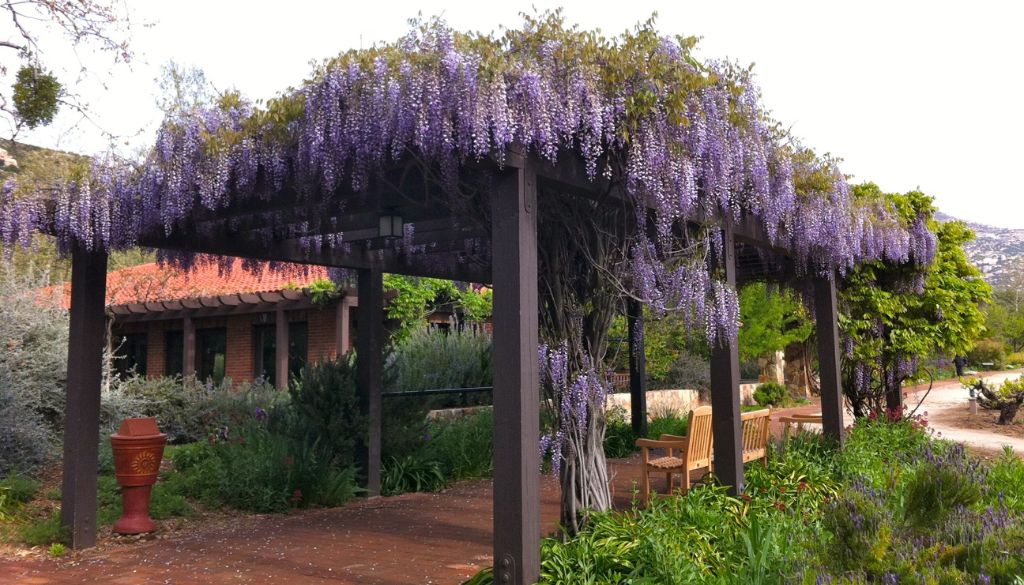
Creative Design Ideas: How to Use Wisteria in Your Garden
Wisteria is one of the most architecturally versatile climbers available to Melbourne gardeners. Beyond the classic pergola draping, there are a number of imaginative ways to feature it:
Pergolas and Outdoor Dining Areas
Draping wisteria across a pergola creates dappled shade through summer while delivering a spectacular overhead canopy of flowers in spring. It’s one of the most requested garden features we design in Eltham and surrounding suburbs.
Framing Doorways, Gates and Windows
Training wisteria to frame an entry gate or a set of French doors adds an immediate sense of romance and arrival. This requires consistent pruning to keep the frame shape clear, but the effect is extraordinary.
Wall Espalier
Trained flat against a masonry wall on a wire system, wisteria creates a living tapestry effect. This approach works particularly well on long boundary walls or the side of a garage. Our guide on landscaping ideas for the side of your house explores how climbing plants like wisteria integrate with narrow space design.
Standard ‘Lollipop’ Forms
With patience and consistent pruning, wisteria can be trained into a standard tree form — a clear stem topped with a weeping flowering head. These make exceptional focal points in formal garden areas.
Container Growing on Balconies and Courtyards
Yes — wisteria grows in large containers. Use a half wine barrel or equivalent, with a strong central stake or frame. Container growing naturally limits the root run and spread, making maintenance more manageable.
How Long Until Wisteria Flowers?
Patience is the single most important quality a wisteria grower can possess. Grafted plants typically take two to five years to flower reliably; seed-grown specimens can take up to seven. If your established wisteria still isn’t flowering, the cause is almost always one of these four things:
- The plant is still too young
- It is not receiving enough direct sunlight
- The soil is too nitrogen-rich — often from over-fertilising nearby lawn or garden beds
- It has not been pruned correctly
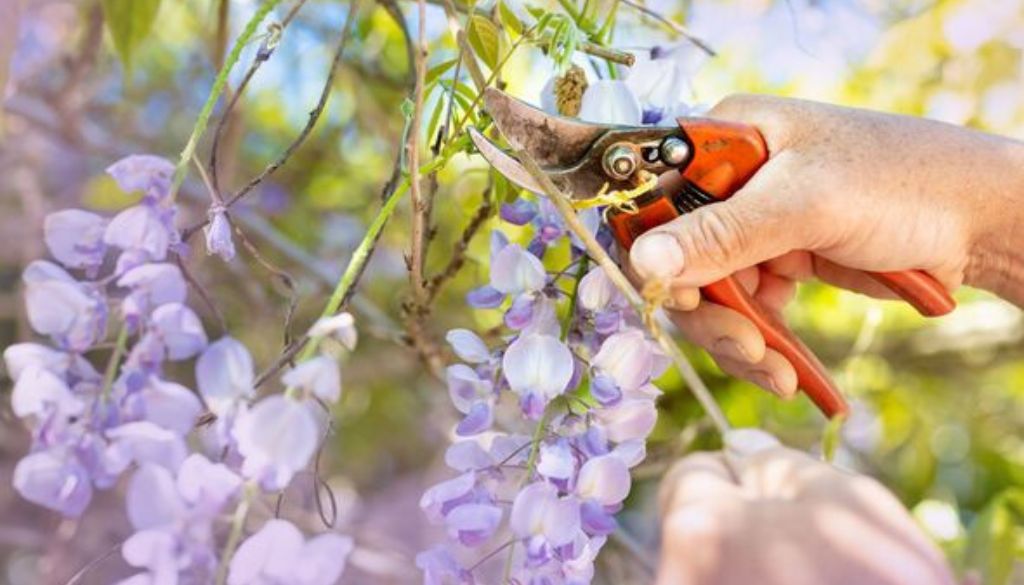
Pruning Wisteria: The Secret to Spectacular Flowering
Pruning is the make-or-break practice for wisteria. Without it, the plant becomes an unruly mass of whippy stems with poor flowering. With it, you develop the short flowering spurs that deliver that breathtaking spring display year after year.
The Two-Cut Method
Summer Prune (late spring to early summer, after flowering): Cut all the long new shoots back, leaving five to six leaves. Shape the plant and remove growth heading in the wrong direction. This is also when you establish or reinforce the framework of the plant.
Winter Prune (July–August in Melbourne): Shorten the same shoots again, this time back to two or three buds from the base. These short stubs become the flowering spurs that burst into bloom the following September. Remove any seed pods you don’t want.
These two cuts each year — while the plant is in growth and while it is dormant — are what separates a flowering wisteria from a green tangle.
Common Mistakes to Avoid
- Overfeeding — High-nitrogen fertilisers push leafy growth at the expense of flowers. Feed lightly with a low-nitrogen, high-potassium fertiliser only.
- Insufficient support — Underestimating the eventual weight of a mature wisteria is one of the most expensive mistakes in garden design. Build for 20 years, not two.
- Skipping or incorrect pruning — The plant will become increasingly dense and produce diminishing flower returns without the two-cut annual regime.
- Deep shade — Even a few hours less sun per day dramatically reduces flowering performance.
- Planting near structures — Roots can penetrate and damage foundations, drains and paving over time.
Safety Notes: Invasiveness and Toxicity
Is Wisteria Invasive?
Chinese and Japanese wisteria can become invasive when left unpruned in temperate gardens, and in some parts of the world they are classified as environmental weeds. In the Melbourne context, regular pruning and responsible seed pod removal manages this risk for most suburban gardens. If you have concerns, the American varieties (particularly ‘Amethyst Falls’) are a lower-risk alternative.
Is Wisteria Poisonous?
Yes. All parts of the wisteria plant — including the seeds, pods, and bark — are toxic if ingested, and can cause gastrointestinal distress in both children and pets. We always discuss plant safety as part of our initial design consultations.
Frequently Asked Questions
Why is my wisteria not flowering?
When is the best time to prune wisteria in Melbourne?
Is wisteria safe to grow near my house?
Which wisteria variety is best for a small Melbourne garden?
Can I get professional help designing a garden around wisteria in Melbourne?
Is Wisteria Right for Your Garden?
Wisteria is not a low-maintenance plant. It requires correct structural support, consistent annual pruning, and some patience before it reaches its full potential. But for homeowners who are prepared to give it that seasonal attention, it delivers a spring display that is unmatched in the garden — romantic, structural, fragrant, and dramatic in equal measure.
The gardens we most love to design are the ones that evolve with their owners over years. Wisteria is one of those plants that improves with age when managed well. Paired with a thoughtfully designed pergola, stone paving, and a considered planting palette of companion shrubs, it becomes the centrepiece of an outdoor room that genuinely adds value — in liveability and in property terms — to a Melbourne home.
If you’re thinking about introducing wisteria to your garden, or planning a broader outdoor redesign for your Eltham, Kew, Alphington, or Doncaster East property, we’d love to hear from you. Contact John French Landscape Design to arrange an in-home consultation and start the conversation about what’s possible for your space.
To understand more about our design approach and the breadth of garden styles we work with, visit our About page. And if you’re new to garden planning altogether, our landscaping for beginners guide is a great starting point before booking a consultation.
