
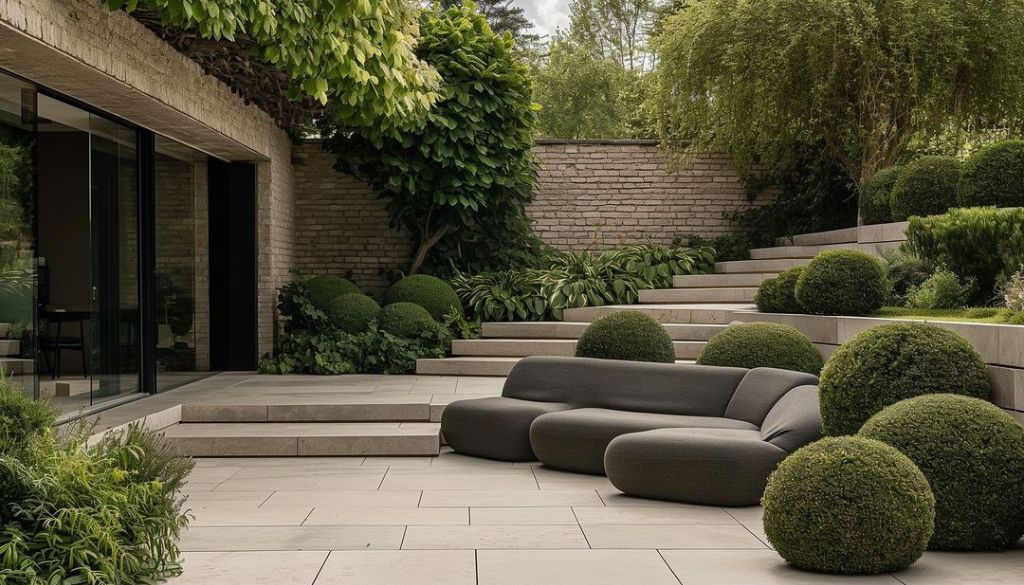
The difference between a garden that looks expensive and one that truly is expensive often comes down to a single, deceptively simple decision: material palette.
Pick the wrong combination — travertine paving next to cream render next to pale timber decking — and everything blurs into a wash of beige. Pick the right one, and a garden gains presence, coherence, and a quality that’s immediately legible to anyone who steps into it.
The best Melbourne garden designers don’t select materials one at a time, pricing each piece individually and hoping for the best. They compose palettes — curated combinations of stone, metal, timber and planting — the way an interior designer assembles a room. Tonal relationships, textural contrast, material character: these are the levers that separate a good garden from a genuinely exceptional one.
Melbourne has cultivated a particularly strong design culture for outdoor living. Its climate rewards ambitious gardens; its architecture — from Victorian terrace houses to contemporary black-clad builds — demands them. And its homeowners, increasingly, understand the language of design. They’re not just asking what to plant. They’re asking why certain combinations feel right.
This guide explores four of the palettes that currently define high-end garden design across Melbourne — what they’re made of, why they work together visually, and the kinds of properties and lifestyles they suit best.
Every palette explored in this guide is best realised through a considered, end-to-end process — from site analysis and concept through to construction. To understand how that process works in practice, explore our custom landscaping services and how we tailor each project to the individual property.
Palette 1: The Melbourne Classic — Bluestone, Off-Form Concrete & Australian Natives
If there is a signature palette of contemporary Melbourne garden design, this is it. Walk through Carlton, Fitzroy or Kew, and you’ll encounter it again and again — and it never loses its appeal. That’s because it draws on materials that are genuinely local, genuinely honest, and genuinely suited to the city’s mood.
The Materials
Bluestone (basalt) paving and coping is Melbourne’s own stone — quarried from the Western Plains and used in the city’s laneways and cobbled streets for over 150 years. Off-form (board-formed) concrete brings rawness and architectural weight: retaining walls, garden beds and steps finished with the impressed grain of timber shuttering. And Australian native planting — lomandra, westringia, kangaroo paw, Dianella, native grasses — bridges hardscape and softscape with silver-green and charcoal foliage tones that complement both.
Why It Works Visually
This palette succeeds through tonal cohesion and textural contrast working simultaneously. All three elements sit within the same cool grey-green-charcoal register. There’s no material here that pulls toward warmth, no unexpected colour note that forces resolution. The palette is tonally resolved before a plant is placed.
But within that tonal unity, the textures couldn’t be more different. Honed or sawn bluestone has a refined flatness — precise, architectural, almost ink-like when wet. Off-form concrete carries the organic memory of its timber formwork, grain and all. And the native planting — feathery, linear, occasionally spiky — introduces movement and softness that neither hard material can provide.
The result is a palette that feels simultaneously designed and inevitable. It doesn’t announce itself. It simply looks correct.
Where It Excels
This combination is particularly powerful alongside red-brick Edwardian and Victorian homes, where the cool grey tones of bluestone provide a modernising counterpoint without erasing the warmth of heritage brick. It also works beautifully in inner-city courtyard gardens, where off-form concrete walls substitute for built structure and native grasses fill small planting zones with enormous visual energy.
Getting a bluestone and native palette right requires more than selecting good materials — it takes a designer who understands Melbourne’s climate, soil conditions and architectural context intimately. Learn more about what to look for when choosing a landscape designer in Melbourne for your next project.
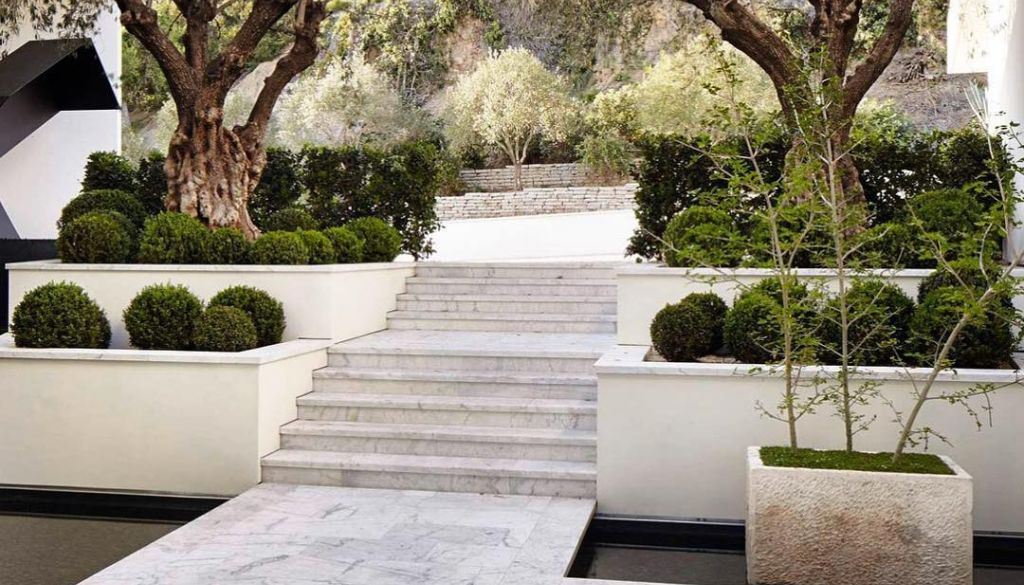
Palette 2: Warm & Timeless — Travertine, Olive Tones & Mediterranean Planting
Where bluestone and concrete speak to Melbourne’s urban grit and design sophistication, travertine speaks to something older and more sensory: the feeling of a sun-warmed terrace, a glass of wine at dusk, a garden that invites you to slow down.
This palette has gained significant momentum across Melbourne’s eastern and bayside suburbs, where larger blocks, pool installations and generous alfresco entertaining areas align perfectly with its proportions and mood.
The Materials
Travertine paving and coping — warm ivory-beige natural stone with characteristic vein patterning — is available in filled-and-honed (smooth, refined) or unfilled (more rustic) finishes. Olive, sage and terracotta tones appear in rendered walls, powder-coated steel, outdoor furniture and aged-bronze ceramic pots. The planting palette draws on the Mediterranean canon: olive trees, lavender, rosemary, agapanthus, clipped Italian cypress, box hedging and iceberg roses — structure and softness in equal measure.
Why It Works Visually
Travertine’s defining quality is its warmth — and its ability to carry warmth into the entire palette around it. Ivory and beige are neutral enough to recede, but the natural variation in travertine’s vein patterning adds a quiet complexity that prevents the palette from feeling flat.
The olive and sage tones in pots, furniture and planting pick up the stone’s undertones and amplify them, creating the tonal cohesion that makes the palette read as intentional rather than assembled. Terracotta accents — a pot, a wall wash, a coping detail — add warmth without tipping into the merely decorative.
Perhaps most importantly: this palette photographs exceptionally well. The warm tones glow in Melbourne’s afternoon light, particularly in north-facing gardens. The combination of travertine’s horizontal plane and vertical Mediterranean planting also creates a visual depth that smaller palettes struggle to achieve.
A Practical Note
Travertine requires sealing in Melbourne’s climate — its porous nature means it can absorb moisture, staining and organic matter if left untreated. A quality penetrating sealer applied on installation, and reapplied every three to five years, maintains both its appearance and longevity. This is worth raising with clients upfront. It’s a manageable requirement, and one that signals material quality rather than liability.
Where It Excels
This palette is the natural choice for pool surrounds — travertine’s thermal properties mean it stays cooler underfoot in summer than many alternatives, and its slip-resistant texture in an unfilled finish suits wet areas well. It also works beautifully in alfresco dining areas of homes with render finishes, terracotta roof tiles or Hamptons-influenced architecture.
Travertine, granite and corten steel all fall under the broader category of hardscaping — the structural, non-living elements that form the bones of any great garden. For a detailed breakdown of the options available for your outdoor space, see our guide to hardscaping materials and design.
Palette 3: Industrial Edge — Corten Steel, Ornamental Grasses & Dark Hardwood
Of all the palettes explored here, this is the one that most rewards patience. Corten steel — the weathering steel alloy used in retaining walls, raised garden beds and sculptural water features — arrives on site with a grey-silver finish. Over six to eighteen months, it slowly transforms, developing the rich, stratified rust patina that makes it one of the most visually arresting materials in contemporary landscape design.
Pair it with ornamental grasses and dark hardwood, and you have a palette that is genuinely singular: warm, organic, architectural, and utterly distinctive.
The Materials
Corten (weathering) steel is used as raised garden bed edging, retaining walls, water feature construction and garden screens. Its self-protecting patina means no painting is required — the rust is the finish. Ornamental grasses — pennisetum, miscanthus, feather reed grass, native kangaroo grass — range from arching and billowing to upright and architectural. Dark hardwood timber (spotted gum, blackbutt, or treated timber with a dark stain) appears in decking, screens, pergolas and outdoor furniture.
Why It Works Visually
This palette operates through tonal echo — a technique where related but not identical colours across different materials create deep visual resonance rather than simple repetition. The rust-orange of aged corten, the bronze-amber of dried or autumn grasses, and the deep warm-brown of dark hardwood all occupy the same warm-dark register. They are variations on a theme, not a matched set.
Against this warm tonal bed, the contrast between material characters is extreme: the hard, geometrically precise edges of corten steel against the soft, billowing, kinetic forms of ornamental grasses. This kind of contrast — rigid versus fluid, industrial versus organic — is the visual tension that makes the palette feel alive rather than merely assembled.
It also offers something few garden palettes can claim: dramatic seasonal interest. Ornamental grasses transform through the year — green and upright in spring, full and swaying in summer, bronze and luminous in autumn, skeletal and architectural in winter. The garden is never static.
Where It Excels
This palette was made for new builds with dark-clad or black-rendered facades, where the tonal relationship between exterior cladding, dark timber and corten steel creates a cohesion that feels completely resolved. It also works exceptionally well in larger suburban gardens where the vertical movement of grasses provides scale and the corten elements anchor the space without dominating it.
If the corten and ornamental grass palette appeals to you, native planting is a natural next step — many of Australia’s most striking grasses and groundcovers work beautifully alongside weathering steel. Explore our collection of DIY native plant landscaping ideas to find species that suit your space and climate.
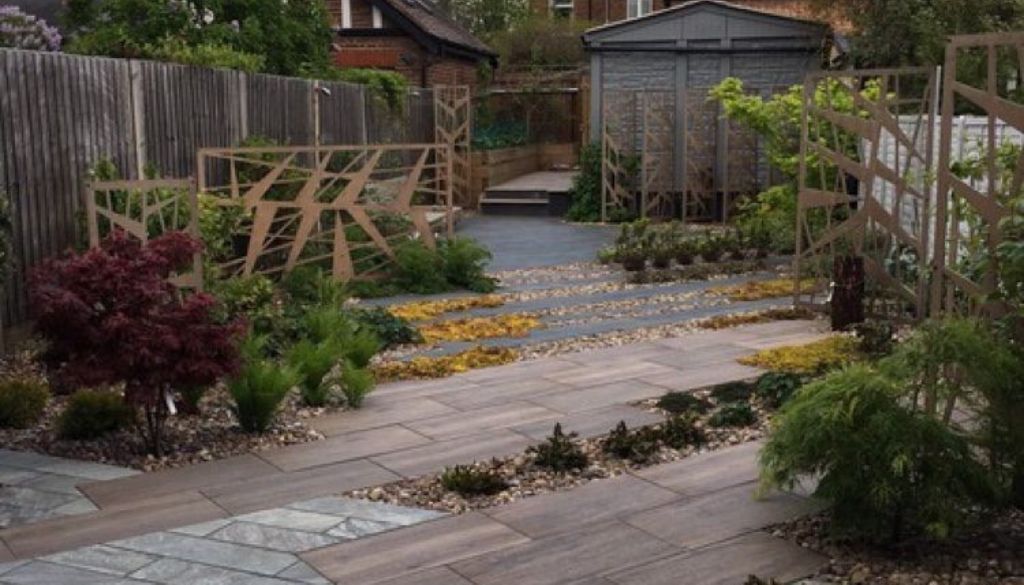
Palette 4: Refined Restraint — Granite, Clipped Hedging & Silver-White Planting
The fourth palette is the most demanding — and, executed well, the most quietly impressive. Granite, clipped formal hedging and a white-and-silver planting scheme is a composition that trades entirely on restraint. There is no material here that calls attention to itself through colour or texture alone. What it communicates instead is quality — in material, in maintenance, and in the decisions that assembled it.
The Materials
Granite paving in grey, blue-grey or black tones is denser and finer-grained than most alternatives. Less common than bluestone in Melbourne, which gives it a more exclusive register — it takes an exceptionally refined sawn or polished finish. Clipped formal hedging — buxus, Portuguese laurel, murraya or English box — provides geometric structure: cubes, spheres, topiary forms, tightly maintained walls and partitions. The planting scheme is built from white and silver: iceberg roses, Salvia leucantha, artemisia, white agapanthus, silver-leaved Plectranthus and white-flowering Choisya.
Why It Works Visually
This palette is built entirely on monochromatic discipline. By limiting the colour range to cool neutrals — granite grey, deep green hedging, white and silver flowers and foliage — it removes colour as a tool entirely and forces material quality and form to carry the design.
Granite’s fine grain and precise finish reads as uncompromisingly high quality: the kind of material that communicates investment without advertising it. Clipped hedging introduces geometry and structure, creating the strong architectural bones that formal gardens require. And the white-silver planting scheme provides light without warmth, movement without noise — the visual equivalent of a whisper.
This palette also improves at dusk. White flowers and silver foliage have a luminosity in low light that most other planting colours cannot match. A garden designed in this palette is at its most beautiful in the hour before dark — a genuine asset for evening entertaining.
Honest Considerations
This is the most maintenance-intensive palette of the four. Clipped hedging requires regular shearing to hold its forms; formal gardens read poorly if maintenance lapses. Granite’s cost per square metre is higher than most alternatives. And a white-silver planting scheme requires careful species selection to ensure tones don’t drift toward cream or yellow as flowers age.
For the right client — one with the budget, the maintenance commitment, and a property that suits formal geometry — this palette produces gardens of rare, enduring distinction.
Where It Excels
Formal garden schemes, heritage properties where architectural structure is needed to complement the building, and front gardens where kerb appeal is the priority. Also well-suited to gardens designed for evening entertaining, where the luminosity of white and silver is a genuine asset.
Target keywords: granite paving Melbourne, formal garden design Melbourne, clipped hedge garden design, white garden planting scheme
Choosing the Right Palette for Your Melbourne Garden
Every palette explored here can produce an exceptional garden. None of them is universally right — and that’s precisely the point. The selection process matters.
Three factors should drive the decision. First, the architecture of the home: what materials and tones does the building itself use? A palette that harmonises with the facade will always read as more considered than one that ignores it. Second, orientation and light: cool palettes like bluestone and concrete perform best in south-facing gardens or shaded courtyards, where their tonal precision is legible all day. Warm palettes like travertine and corten come alive in north and west-facing spaces, where afternoon light amplifies their richness. Third, how the space will be used: a high-footfall entertaining area demands durable, low-maintenance materials; a contemplative garden for a single household can accommodate more refined and demanding choices.
Beyond these practical considerations, there’s a more intuitive principle worth applying: think in tonal families, not individual materials. Every palette here works because its elements share underlying tonal values. Before committing to a material, ask not just whether you like it, but whether it belongs to the same tonal conversation as everything else in the scheme.
The most enduring gardens in Melbourne — the ones that appear in publications, that attract clients to particular designers, that become genuine assets rather than merely attractive additions — are the ones where these decisions were made deliberately and early. Material palette is not a finishing touch. It is the foundation.
If you’re approaching garden design for the first time, understanding how materials, plants and layout decisions interact can feel overwhelming — but it doesn’t have to be. Our beginner’s guide to landscaping is a practical starting point before committing to any palette or design direction.
Frequently Asked Questions
What is the most popular paving material for high-end gardens in Melbourne?
Bluestone remains the most widely used material in premium Melbourne garden design, largely because it’s locally quarried, climatically suited and architecturally versatile. It pairs well with both heritage homes and contemporary builds, and its cool grey tones complement a wide range of planting styles. Travertine has grown significantly in popularity for pool surrounds and alfresco areas, particularly in Melbourne’s eastern and bayside suburbs.
Is travertine suitable for Melbourne’s climate?
Yes, with the right preparation. Travertine is a porous natural stone, so it needs to be sealed on installation and resealed every three to five years to protect against moisture, staining and organic matter. A quality penetrating sealer handles this easily. In an unfilled, brushed finish, travertine also provides excellent slip resistance around pools and in wet areas — making it both practical and beautiful in Melbourne’s outdoor living conditions.
How long does corten steel take to develop its rust patina?
In Melbourne’s climate, corten steel typically develops its full rust patina within six to eighteen months, depending on how much exposure to rain and humidity it receives. During this transition phase, tannin-coloured water can run off the surface — worth factoring into placement decisions, particularly near light-coloured paving. Once the patina stabilises, it’s self-protecting and requires no ongoing maintenance.
Can I mix materials from different palettes?
Thoughtfully, yes — but the tonal relationship between materials matters more than the combination itself. The reason each palette in this guide works is that its elements share underlying tonal values. If you borrow a material from one palette and introduce it into another, ask whether it belongs to the same tonal family. Corten steel and bluestone, for instance, can coexist because both carry dark, saturated tones. Corten and travertine are harder to resolve — their warm and cool registers pull in opposite directions.
How do I choose between a formal and informal planting style for my Melbourne garden?
The architecture of your home is usually the clearest guide. Formal clipped hedging and structured planting schemes suit symmetrical facades, heritage properties and homes with strong geometric lines. Informal native or Mediterranean planting suits contemporary builds, asymmetrical layouts and gardens where a more relaxed, naturalistic feel is the goal. When in doubt, let the hardscape materials lead — they’ll tell you what kind of planting they want around them.
Ready to Design Your Dream Garden?
Whether you’re drawn to the cool precision of bluestone and concrete, the sun-soaked warmth of travertine, the industrial character of corten steel or the quiet luxury of formal granite — the right material palette makes all the difference.
John French Landscape works with Melbourne homeowners to create gardens that are designed with intention, built to last, and tailored to the way you actually live. Get in touch today for a consultation.
